10 Ways to be with children that help in healing.
Parents and other caregivers whose children have experienced traumatic events, especially events related to becoming a refugee, often feel at a loss as to what they can do to help their kids. Here are some ideas that might be helpful. It is especially difficult to help if those adults are extremely upset also.
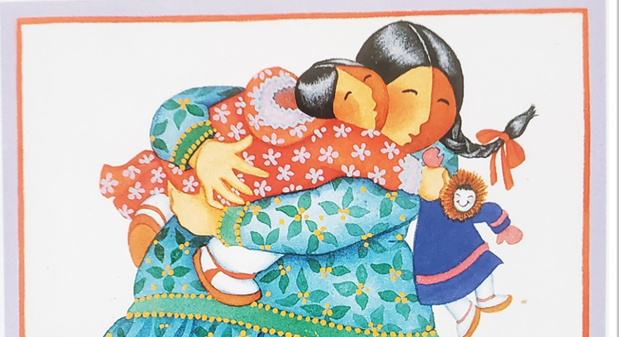
1. Comfort your child. Hold your child. Cuddle them. Even infants feel fear and anxiety of trauma although they cannot express it in words. Touching your child is especially important at this time.
Reassure your child, ”We are together. We love you. We will protect you.” Yes, comforting your child is important, it’s very important, but it’s also important that you provide some structure to their lives. Surviving in a traumatic situation frequently means having to deal with chaos. Survival. Doing the best one can, in any way, to stay alive. There has been no structure, no leadership, no plan, few if any resources to help.
Children need structure. They need leadership. They need someone to help plan their lives now that they are safe. Parents are those people. Whereas structure is important it’s also important to give opportunities for children to make choices. Yes, they may need someone to fix the meals yet let your child choose some of the foods and help with the preparation of what they will eat. Yes, structure is important and in their development they also need opportunities to choose; for them to make decisions at their level.
One resource that parents will be able to use if your child is old enough is school. One of the values of school is the structure it provides – schedules, use of materials, studying specific topics, learning to know new friends, taking turns, listening to others, patience. Schools need to help parents understand the school system their child will be being part of and parents should take advantage of some of the opportunities schools offer.
Remember that sometimes children do not show negative effects from their traumatic experiences immediately. They may feel them but may not show it in their behavior or in the words they use. It may take them weeks for their behaviors to change or it may be several months before you notice changes. If that is the case and the changes last for several weeks find additional help through someone in your ethnic community, from your faith community, school, or some other agency knowledgeable about children. Even though you do not see changes in your child’s behavior work with him or her as described in this paper for the material is based on valid child development information which could apply for any child.
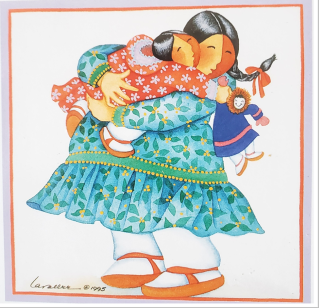
Art by Barbara Lavallee
2. Spend extra time putting your child to bed at night. Talk with them and offer assurance. Leave the night light on if necessary. Rub your child’s back. Read a story to your child or tell a story your grandmother told you when you were going to sleep as a young child. You might sing a favorite song from your childhood. Help your child get the sleep he or she needs.
3. Be patient – Be extra patient with your child. Being patient may be difficult if you are tired or children are especially active, but each child deserves the adults in their lives to treat them with patience, care and respect.
4. Talk with your child – Talk to your child about your own feelings as well as theirs. It is important for them to know that you have feelings also. But remember to talk with them at a level of understanding. Give facts. Be honest and answer their questions as clearly as possible. It’s OK to say, “I don’t know but I’ll try to find out.” Be sure to get back to your child if you get an answer to your question or let them know if you do not find an answer. Be prepared for more questions from your child as time goes on and they have had an opportunity to think more about what happened. Unless you observe unusual behavior let your child ask questions rather than you bringing up the subject. Be sure to help your child understand they had nothing at all to do with what happened. End discussions about the incident(s) with a positive statement such as, “Yes, it happened but we are safe now.” Speak softly and clearly. You may need to repeat information and reassurances many times. Do not stop responding just because you told the child once.
5. Emotional Literacy – Talking with children about their traumatic experiences is frequently used as a way to help children heal. That process is taken from a western perspective on how to help children recover from traumatic experiences. However, people who come from different backgrounds may use different strategies. Whereas it is important for parents to help children use words for their feelings it is also important to realize that children who have experienced trauma and exposure to unsafe environments communicate better through visuals than words. Storytelling, music, the arts, or games can be very effective in communicating feelings. In fact, it has been found that refugees are more comfortable with silence than with verbal communication, But if parents have worked with their children on learning the words describing feelings or emotions your children will be able to express themselves verbally when they are ready. They will let you know when that time comes.
6. Listen to your child – Listen to your child without judging what has been said. Is there fear, anxiety, insecurity? Your repeating the child’s words may be very helpful, such as, “You are afraid that ………” or “You wonder if the fighters will find you even where you are now!” or “You wonder if your mother will be there when you get home!” Speaking about it helps both you and the child clarify feelings. Remember that feelings are not bad. They just are a part of life, and everyone has them. Your job as a parent is not to deny them but to help your child work through them – to feel safe, to feel more in control, more relaxed and able to have fun. Having fun is important when one works with children who have gone through traumatic experiences. Let your child take his or her time to figure things out and to form their opinions. Don’t rush them or pretend they don’t think or feel as they do
7. Stay together as a family as much as possible. Be sure to re-establish contact with extended family if possible. Help your children learn to trust adults by keeping promises As well as to include children in planning routines and outings. Help your children know that others love and care about them by visiting, talking on the phone or writing to family members, friends and neighbors. Encourage children to send pictures they have drawn or things they have written to family or friends who live in another place. That helps them stay connected to people who have been in their life in the past. Help your child regain faith in the future by helping them develop plans for activities that will take place later — next week, next month.
8. Be calm and relaxed – talk quietly and move slowly – Children have already experienced a lot of noise, confusion, chaos and panic. Speaking with them in a quiet voice and moving slowly helps establish calm and relieve stress. It is not always easy to be calm and quiet when working with children who are as active and demanding as displaced children often are. But if you can maintain that attitude and way of being, children can settle down and be more relaxed themselves. Remember, children everywhere can be easily excitable.
9. Be predictable – Displaced children have very few things in their current lives that are predictable. But since predictability is very important in a child’s development, you can help them understand the concept of ‘if-then’.- if this happens – this will be the result. For instance, if you, the parent, or caregiver, tells the child that it is time to go to bed and when the child does that you will sing them a song that your mother taught you when you were a child. If – then or if it is time to eat you tell the child that if he/she sits down you will serve the food. — if – then. Here is one more example:” If you get dressed then we can visit a friend.”—if – then.
Children may have trouble with the – if/then – way of thinking. But you can help them practice by making a promise and following through. Be sure you strictly follow your own directions. Since war and violence sometimes results in children’s not trusting adults – remember to only make promises that you know you can keep.
10. Smile – A child’s smile is much more than just a sign of happiness, they say. It can be a powerful tool to shape their entire life. Quoting from KUHLA Education in Kawa-Zulu, Natal, South Africa, (one of my US Peace Corps assignments) Teachers are encouraged to work with their children with a smile. For, they say –
A smile Is Power
A Smile Welcomes
A Smile Reassures
A Smile says, “You can do this.”
YES – you can do this! As your children need you, you can experience great benefit from being with them and helping them recover.